Rambler
Massive congratulations on making it to Module Three of Banjo Adventures!
By the end of this video lesson: You'll have learned a brand-new chord shape that naturally evolves from D7. We’ll then use that chord to play the tune Old Joe Clark. Most importantly, you'll begin to understand that banjo doesn’t have to feel difficult—especially when we look at things with fresh eyes and break challenging ideas into simple, digestible layers. That’s how we make real progress, at our own pace and on our own terms.
Now, typically after learning the D7 chord, most banjo players move on to the C chord—and for good reason. The C chord shows up in loads of tunes in standard open G banjo tuning. But in this lesson, we’re going to take a slightly different path and explore a lesser-used chord: the F6.
This isn't about being contrarian. It’s about showing you—right here, early on in your banjo journey—that even something that looks complex can be broken down into steps that are totally manageable.
Just think how far you’ve already come since Day One. You’ve built up a solid foundation of skills and techniques. Banjo Adventures is designed to break the learning process into clear modules and layers—so we can tackle new challenges without feeling overwhelmed.
Take a look at the banjo chord chart below. If I simply asked you to memorise every chord on it, you’d probably feel completely swamped. There are hundreds of possible chord shapes to learn with our fretting hand—but here’s the thing no one will tell you: you don’t need to learn most of them. In fact, you likely never will. How cool is that! I used to stare at these chord charts and think to myself, “should I just start at the top left and work my way down memorising each one of them one after the other?”
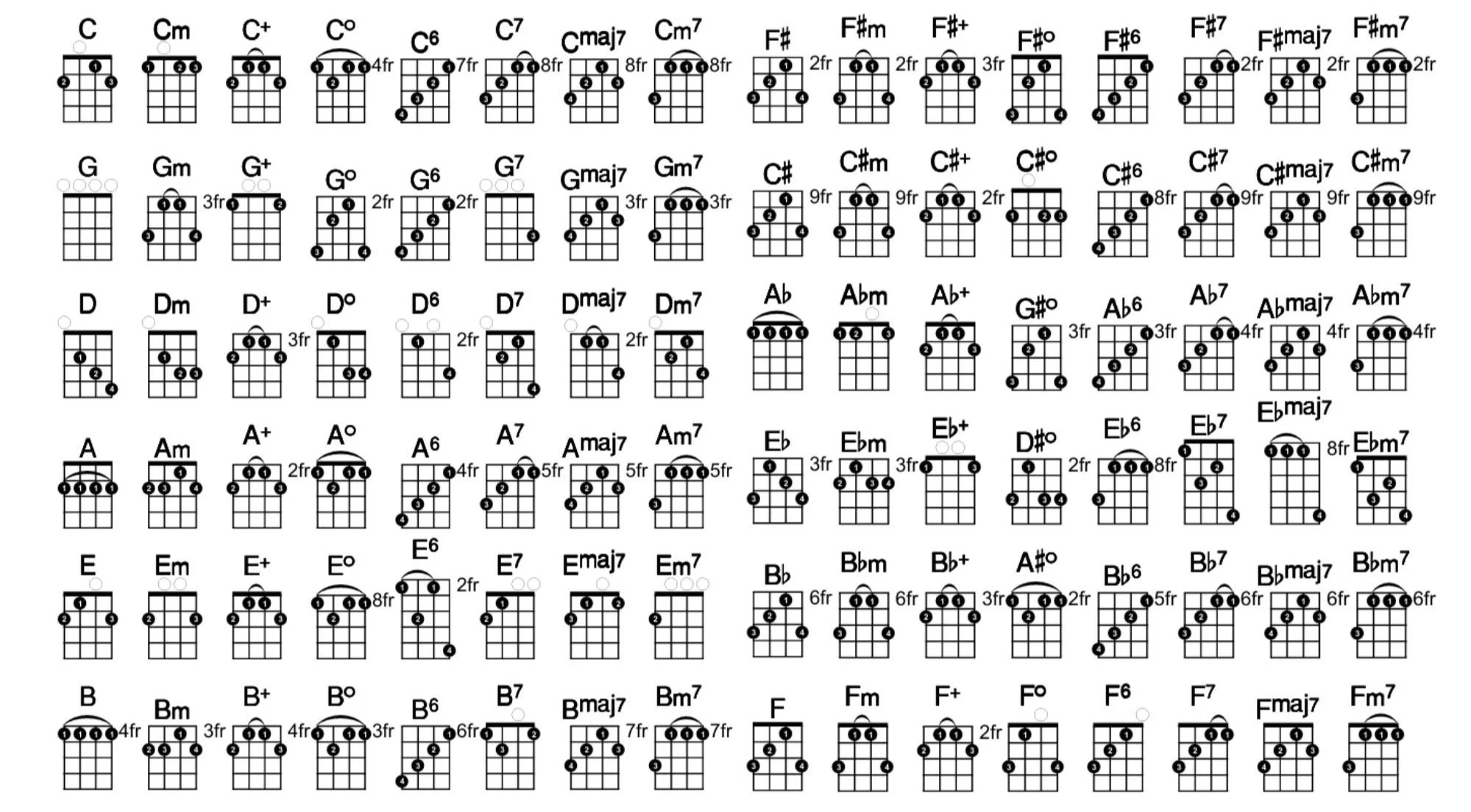
You’ve already demonstrated yourself how just two chords—Open G and D7—can be used to play real tunes on the banjo. If we add just a few more chords to our toolbelt we suddenly unlock THOUSANDS of musical possibilities. That’s more than enough to keep us exploring and playing for a long, long time wouldn’t you agree?
Now check out the modified chord chart below. I’ve circled the primary chords in blue that we’ll be using throughout your banjo adventure in standard open G tuning.
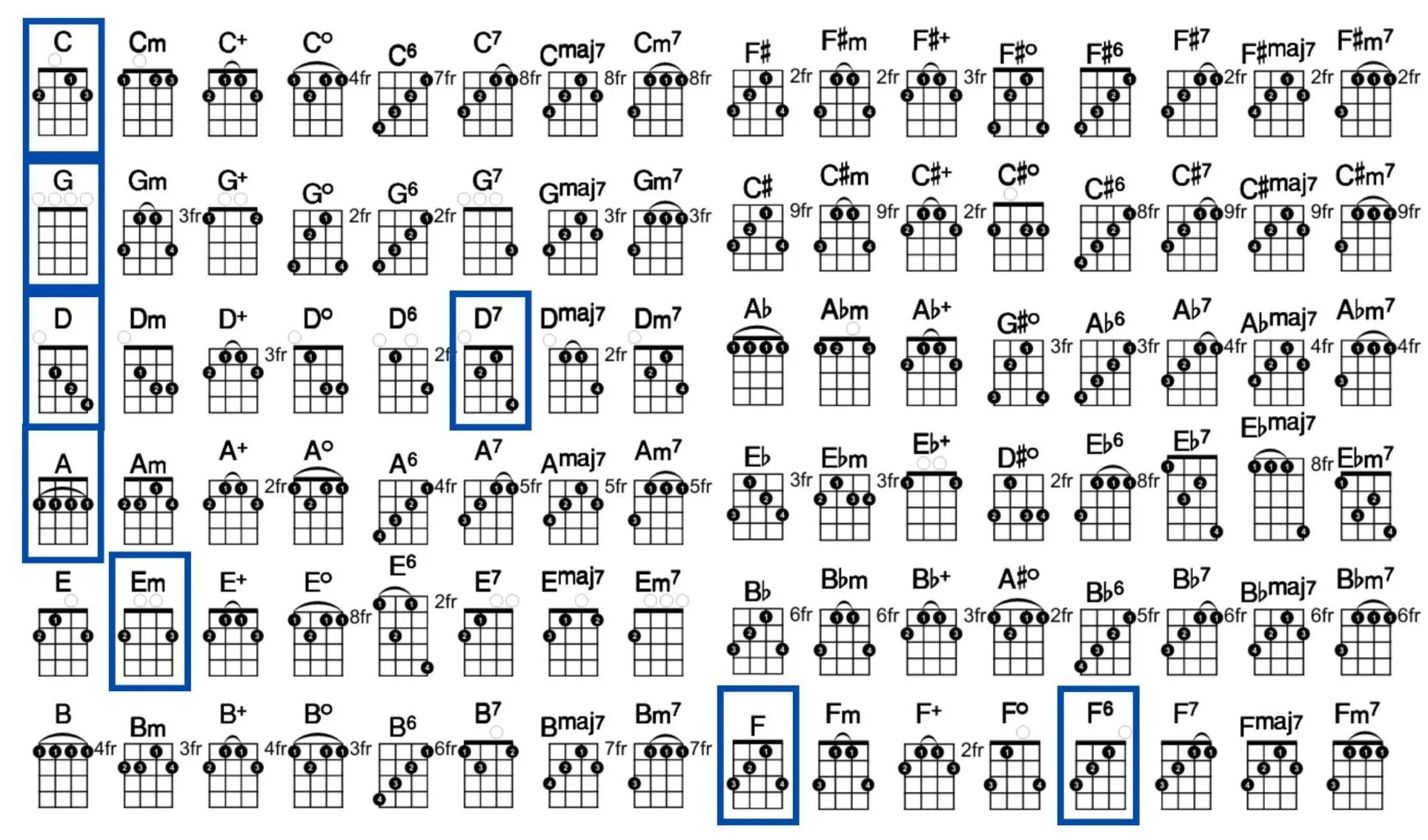
Doesn’t that look way more manageable? I wasn’t joking when I said we don’t need to learn most of them. Open G and D7 are already in the bag, by the end of this video we will have the F6 chord and possibly even the F chord in the bag. That’s 4 out of 8 chords learned by the end of this video lesson. Talk about progress in disguise!